
👩🏫 The Procurement Dilemma: Why Food-Grade PCR Sourcing Feels Like a High-Stakes Gamble
For procurement managers, packaging engineers, and sustainability directors in the food and beverage sector, switching from virgin polyethylene terephthalate (vPET) to post-consumer recycled PET (rPET) feels like navigating an obstacle course. Corporate ESG roadmaps demand a 25% to 50% post-consumer recycled (PCR) resin content to comply with evolving regulations such as the EU Packaging and Packaging Waste Regulation (PPWR) and US state-level minimum recycled content mandates. However, the manufacturing floor operates on zero-tolerance realities: yellowing bottle walls, volatile intrinsic viscosity (IV) causing blow-mold blowouts, and, most critically, the catastrophic risk of biological or chemical migration violating food safety regulations.
When a procurement team purchases an unverified batch of recycled resin, they are not merely risking cosmetic defects; they are risking brand equity, product recalls, and severe regulatory penalties from agencies like the US FDA or the European Food Safety Authority (EFSA). The common trap lies in purchasing industrial-grade or non-food-grade rPET based solely on lower spot prices, only to discover that the material lacks a Letter of No Objection (LNO), exhibits unacceptably high acetaldehyde (AA) levels, or generates excessive haze in transparent preforms.
This guide provides an end-to-end framework to evaluate food-contact compliance, stabilize intrinsic viscosity, eliminate optical contamination, and model pricing per metric ton. By treating recycled resin procurement not as a transactional commodity purchase, but as an auditable technical system, your engineering and sourcing teams can deploy transparent rPET pellets that satisfy compliance audits, preserve mechanical throughput, and protect packaging unit economics.
🎯 The Decontamination & De-polymerization Ledger: The rPET Operational Framework
To understand food-grade rPET, think of your resin supply chain as an auditable “accounting ledger” for polymer purity. In virgin PET manufacturing, the raw feedstocks (purified terephthalic acid and monoethylene glycol) enter a closed, pristine petrochemical process. In rPET manufacturing, your material input has lived an entire life cycle in the hands of consumers. It has been exposed to UV light, misclassified waste streams, residual food oils, cleaning agents, and non-food storage containers.
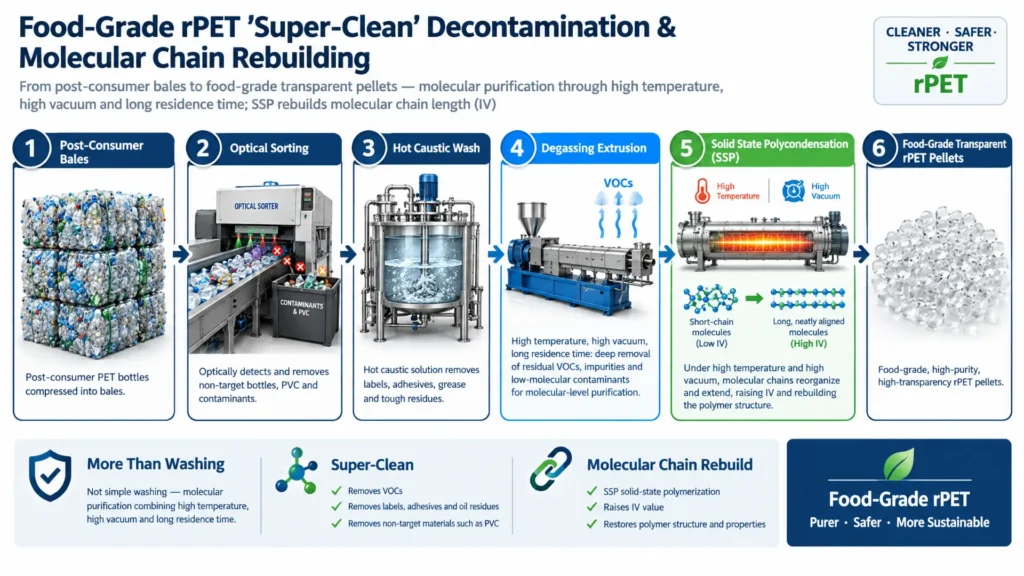
Transforming that mixed stream into food-contact resin requires two synchronized engines: deep decontamination technology (super-clean mechanical recycling or chemical glycolysis/methanolysis) and solid-state polycondensation (SSP). SSP acts as a “molecular reconstructor,” lifting intrinsic viscosity back to virgin-grade baselines while driving volatile organic compounds (VOCs) and contaminants below strict toxicological thresholds.
| Component / Layer | Technical Parameter / Specification | Operational Translation & Plain Definition |
|---|---|---|
| Feedstock Purity (Flake Input) | Color Sorting (L* > 85, b* < 1.5) & PVC Contamination (< 10 ppm) | The clean raw material base: clear post-consumer bottle flakes rigorously stripped of labels, adhesives, metal, polyolefins, and PVC to prevent yellowing and black specs during melt extrusion. |
| Deep Decontamination (Super-Clean / SSP) | High Vacuum (< 1 mbar), High Temp (200°C–220°C), Residence Time (4–8 hrs) | The purification and rebuild engine: heat and vacuum strip volatile migrants and reconstruct shortened polymer chains, restoring IV and meeting FDA challenge test standards. |
| Optical & Rheological Output | Intrinsic Viscosity (0.78–0.84 dL/g), Haze Index (< 2.5%), Acetaldehyde (< 1.0 ppm) | The production-ready pellet: physical characteristics matching virgin resin performance, eliminating bottle cracking in blow molding and unwanted off-taste in beverage filling. |
🔬 Rigorous Food-Contact Compliance: Deciphering FDA LNO, EFSA Opinions, and Challenge Tests
Food contact safety is governed by non-negotiable chemical migration limits. When evaluating an rPET pellet supplier, the fundamental dividing line is whether their decontamination technology has been validated via an FDA Letter of No Objection (LNO) or a positive EFSA Scientific Opinion.
A supplier claiming “food-grade quality” without an official FDA LNO number is a critical compliance red flag. To secure an FDA LNO under 21 CFR 177.1630, a recycling process must undergo rigorous surrogate challenge testing. In this process, flakes are intentionally contaminated with high concentrations of model chemical surrogates representing different chemical classes (e.g., toluene for non-polar volatiles, chlorobenzene for halogenated organics, methyl salicylate for polar organics, and phenylcyclohexane for non-volatile non-polar organics). The super-clean recycling process must demonstrate that cleaning, extrusion, vacuum degassing, and SSP reduce these surrogates below the toxicological threshold of regulation (TOR), generally capping dietary concentration at less than 0.5 ppb.
Technical Implementation Items
- Challenge Test Audit: Demand the supplier’s surrogate challenge testing protocol validation report from an independent accredited testing body.
- FDA LNO Scope Verification: Check the temperature conditions of use (Conditions A through H under FDA guidelines). Confirm if the rPET is approved for hot-fill, room temperature, cold storage, or microwave heating.
- Limiting Secondary Contamination: Ensure the production line uses food-grade lubricants and closed-loop pellet transport systems to prevent contamination during pelletizing.
🔢 Migration and Surrogate Reduction Efficiency Formula:
Decontamination Efficiency (%)=(1−CspikedCfinal)×100
Where Cspiked is the measured surrogate concentration injected into the test batch flakes (e.g., 1,000 mg/kg toluene), and Cfinal is the surrogate concentration detected in the finalized, compounded rPET pellet (which must yield an acceptable dietary exposure <0.5 ppb based on migration models).
🌎 Regulatory Benchmark Reference: Under US FDA Center for Food Safety and Applied Nutrition (CFSAN) guidelines for recycled plastics in food packaging, an LNO confirms that the specific mechanical or chemical reclamation system produces plastic of suitable purity for its intended conditions of use, avoiding adulteration under section 402(a)(3) of the Federal Food, Drug, and Cosmetic Act.
👉 Consult the publicly searchable database of the US FDA Recycled Plastics in Food Packaging Inventory to verify the operational validity of a supplier’s LNO.
📂 Audit Verification Documents:
- Supplier’s FDA Letter of No Objection (LNO) matching plant location and manufacturing line code.
- Third-party laboratory GC-MS migration test reports (less than 12 months old).
- Certificate of Analysis (COA) per delivered batch certifying non-detectable heavy metal levels (RoHS/REACH compliant).
💬 Consultant Experience & Field Pitfall: Never accept an LNO issued to a machine manufacturer as blanket proof that the resin supplier is compliant. Machine builders obtain “generic” LNOs proving that their equipment can decontaminate resin under specific temperatures and residence times. The resin supplier must maintain standard operating logs proving they run the machinery strictly within those validated operating windows.
💎 Optical Clarity and Processing Stability: Controlling Intrinsic Viscosity (IV) and Color L* / b*
The second barrier to rPET adoption is aesthetic and structural failure on high-speed blow molding lines. Virgin bottle-grade PET generally maintains an Intrinsic Viscosity (IV) between 0.78 dL/g and 0.84 dL/g. Mechanical recycling without Solid State Polycondensation reduces molecular chain length due to hydrolytic and thermal degradation during previous service and melt extrusion, collapsing IV to 0.65–0.70 dL/g. Running low-IV material through preform injection molding results in uneven wall distribution, reduced top-load strength, and bursting during stretch blow molding.
Optical clarity presents an equally sensitive challenge. Post-consumer feedstock naturally contains trace adhesives, colored flakes, printing inks, and degraded thermal breakdown products. In the CIE L*a*b* color space:
- L* (Luminance/Brightness): Must be maintained >80 (ideally >85) to prevent dull, gray preforms.
- b* (Yellow-Blue Axis): Must be tightly controlled (ideally between −0.5 and +1.5). A positive b∗ value exceeding 2.5 causes noticeable yellowing that consumer-facing beverage brands reject.
Technical Implementation Items
- Continuous Solid State Polycondensation (SSP): Run pellets through an SSP reactor under inert gas (nitrogen) or vacuum to step-up molecular weight and rebuild IV up to target levels (0.80±0.02 dL/g).
- Acetaldehyde (AA) Scavenging: Acetaldehyde is a thermal breakdown byproduct of PET that imparts a bitter, fruity taste to water. Maintain pellet AA concentration below 1.0 ppm via vacuum stripping and appropriate processing thermal profiles.
- Pre-Drying Protocols: Ensure desiccant drying of rPET pellets to moisture content <30 ppm prior to processing; processing moist rPET instantly triggers hydrolytic degradation in the injection screw.
🔢 Intrinsic Viscosity Rebuilding Target:
Chain Extension Target:IVpellet=IVflake+ΔIVSSP
Where a clean flake entering extrusion has an IVflake≈0.70 dL/g, and thermal degradation during melt filtering drops it to ≈0.66 dL/g. The SSP unit must provide ΔIVSSP≥+0.14 dL/g to achieve a finished pellet IV of 0.80 dL/g.
🌎 Industry Standard Specification: In line with ASTM D4603 (Standard Test Method for Determining Inherent Viscosity of PET) and ASTM D6290 (Color Determination of Plastic Pellets), food-grade packaging converters establish narrow acceptance windows: IV batch variance must not exceed ±0.02 dL/g, and haze delta versus virgin control must remain under 2.0%.
👉 Review technical processing guidelines published by the Association of Plastic Recyclers (APR) Design Guide for exact pre-treatment and thermal limits.
📂 Audit Verification Documents:
- Automated inline IV rheometer data logs from the supplier’s compounding line.
- Spectrophotometer color check sheets showing continuous L*, a*, and b* values per lot.
- Preform haze and transmittance optical test reports using ASTM D1003 standards.
💬 Consultant Experience & Field Pitfall: Beware of resin suppliers using excessive blue or optical toner to mask yellowing. Adding blue-tint additives brings the b∗ value down toward neutral or negative, but each addition reduces the L∗ value (luminance), resulting in a noticeably darker, gray container when viewed under retail lighting.
💵 Total Cost of Ownership & Price per Metric Ton: Deconstructing the rPET vs. vPET Premium
Sourcing managers frequently experience sticker shock when reviewing food-grade rPET quotes: Why does recycled resin cost $100 to $400 more per metric ton than prime virgin PET made from crude oil?
The economics of food-grade rPET decouple from crude oil pricing because the cost base is tied to the municipal collection of post-consumer bales, deposit-return scheme (DRS) infrastructure fees, optical sorting yields, and the intense energy required by deep-vacuum SSP reactors. When assessing commercial quotes ($/ton), procurement teams must calculate the Total Cost of Ownership (TCO), integrating production line waste, preform rejection rates, and machine downtime.
Cost Driver Decomposition (Per Metric Ton Basis)
- Post-Consumer Bale Purchase & Loss Yield: Clear PET bottle bales carry sorting, washing, and label-removal yield losses of 25% to 35%. Producing 1 metric ton of clean flake requires 1.35 to 1.50 tons of raw bales.
- Super-Clean Processing & Energy Overhead: High-vacuum SSP reactors running continuously at >200∘C for up to 8 hours carry significant thermal and electrical utility costs.
- Certification, Traceability, and Auditing: Maintaining GRS (Global Recycled Standard) chain of custody, third-party lab toxicology screening, and continuous batch tracking represents an operational compliance cost embedded in the price per ton.
🔢 Total Cost of Processing (TCO) Model for Converter:
TCOresin=Pinvoice+Chandling+(Rreject×Cpreform)+(Ddowntime×Cline_hour)
Where Pinvoice is the delivered pellet cost per metric ton, Rreject is the delta in scrap rate caused by rPET black specs or haze compared to virgin, and Ddowntime represents lost capacity from die buildup or filter screen changes.
🌎 Market Price Trend Context: Historically, food-grade rPET has traded at an average premium of 15% to 35% over virgin bottle-grade PET in North America and Western Europe, driven by brand sustainability pledges competing for a finite pool of food-grade certified washed flakes
👉 Monitor real-time resin pricing dynamics, regional indices, and market balance via ICIS Recycling Supply Tracker and Pricing Services.
📂 Audit Verification Documents:
- Formal supplier price escalation contracts indexed to clear recycled bottle bale indices (e.g., RecyclingMarkets.net or ICIS).
- Global Recycled Standard (GRS) Scope Certificate (SC) and Transaction Certificates (TC) validating recycled material volume allocations.
- Plant reject rate comparative reports between virgin baseline runs and rPET trial runs.
💬 Consultant Experience & Field Pitfall: When negotiating supply agreements, avoid entering fixed-price spot purchases during market dips without securing long-term volume allocations. When virgin resin drops, recyclers operating on tight margins throttle processing lines or shutter plants, creating supply shortages and price spikes just as regulatory packaging quotas hit annual compliance deadlines.
📋 Comprehensive Technical Matrix: Food-Grade rPET vs. Non-Food rPET vs. Virgin PET
| Dimension / Metric | Prime Virgin PET (vPET) | Certified Food-Grade Transparent rPET | Non-Food Industrial rPET (Fiber/Strap Grade) |
|---|---|---|---|
| Primary Regulatory Status | Inherently Compliant (21 CFR 177.1630 / EU 10/2011) | Positive FDA LNO (Conditions A-H) / EFSA Opinion | Non-compliant for food direct contact; secondary packaging only |
| Intrinsic Viscosity (IV) | 0.80 – 0.84 dL/g (Tight variance ±0.01) | 0.78 – 0.82 dL/g (SSP adjusted ±0.02) | 0.60 – 0.72 dL/g (Degraded, wide batch swing) |
| Visual Performance (CIE L*, b*) | L* > 90, b* between -0.5 and +0.5 | L* > 82, b* between +0.5 and +2.0 | L* < 75, b* > +3.5 (Visible yellowish/gray tint) |
| Acetaldehyde (AA) Content | < 1.0 ppm | < 1.0 – 1.5 ppm (Optimized for water bottles) | Typically unmonitored (> 3.0 – 10.0 ppm) |
| Contamination Tolerance (Black Specs) | Zero visible specs per 100g sample | < 2–5 minute specs (< 0.2mm) per 100g | Not controlled; frequent screen plugging |
| Primary Sourcing Origin | Petrochemical monomer synthesis | Post-consumer beverage bottles (Deposit Systems) | Mixed post-industrial scrap, thermoforms, mixed curbside waste |
| Standard Commercial Pricing Baseline | Tied to Paraxylene / MEG crude indices | 15% – 35% premium over virgin baseline | 10% – 25% discount relative to virgin baseline |
📊 Processing Roadmap and Auditing Architecture
🧠 Operational Memory Anchor
“Screen the Flake, Rebuild the Chain, Trace the Certificate.”
Purity starts at the bale sorter, strength is rebuilt in the SSP, and compliance lives in the Transaction Certificate.
🖼 Recommended Infographics for Engineering & Procurement Documentation
[Infographic 1: The Closed-Loop Food-Grade Decontamination Journey]
Visualizing the stage-by-stage contaminant reduction and IV restoration:
[Post-Consumer Bales]
       │
       ▼
[Optical & Density Sorting] ──> Removes PVC (<10ppm), Polyolefins, Metals
       │
       ▼
[Hot Caustic Wash & Flake Grinding] ──> Strips Adhesives, Dirt, Surface Contaminants
       │
       ▼
[Extrusion & Melt Filtration (40-50 µm)] ──> Degassing Volatiles & Trapping Particulates
       │
       ▼
[High-Vacuum Solid State Polycondensation (SSP)] ──> Heat + Deep Vacuum (210°C, <1 mbar)
       │                                            ├─ Drives out deep VOCs / Migrants
       │                                            └─ Lengthens polymer chains (IV: 0.66 -> 0.82 dL/g)
       ▼
[Pellet Cooling, Optical Sorting & Packaging] ──> Certified Food-Grade Transparent rPET Pellets
[Infographic 2: The Two-Dimensional Resin Acceptance Envelope]
A coordinate chart for incoming quality control (IQC):
Y-Axis: Intrinsic Viscosity (IV in dL/g, Threshold: 0.78 - 0.84)
X-Axis: Optical Purity (b* Yellow Index, Threshold: < +1.8; L* Brightness: > 82)
Highlighting the green "Acceptable Food-Grade Molding Window" versus the red "Reject Zone" (Hazy, brittle, or yellowed preforms).
[Infographic 3: Document Verification Checklist Flowchart]
Step-by-step documentation gateway for procurement releases:
Check Supplier FDA LNO Scope ──> Match Plant ID ──> Check GRS Transaction Certificate ──> Review Batch GC-MS Migration Panel ──> Clear for Production Run.
📌 Strategic Implementation: Unlocking Sustainable Packaging Success
Procuring food-grade transparent rPET pellets requires bridging the gap between high-level sustainability targets and the practical constraints of the plant floor. Achieving this balance involves a structured, phased implementation:
- Step 1: Audit Regulatory Credentials (Pre-Qualification): Never test material on a commercial line without validating the supplier’s plant-specific FDA LNO documentation, condition-of-use operational envelopes, and GRS Chain of Custody certifications.
- Step 2: Validate Rheological and Optical Windows (Pilot Testing): Run pilot preform molding with a 25% to 50% rPET blend to baseline intrinsic viscosity drop across the screw, preform haze, and cycle-time variation. Require dynamic mechanical and color-meter data verification on every incoming lot.
- Step 3: Establish Index-Linked Long-Term Contracts (Commercial Scaling): Insulate your supply chain against spot-market volatility by establishing clear volume-allocation agreements indexed to audited regional post-consumer bale indices, safeguarding your annual packaging quota from supply disruptions.
As circular economy legislation tightens globally, resin compliance, processing stability, and clear documentation will define market leaders. Integrating technical diligence with rigorous supplier vetting allows brand owners to meet their environmental commitments while maintaining structural integrity, visual appeal, and predictable margins.
📖 Next Step in Your Circular Sourcing Journey → Struggling with Parison Sag and Cracking in Blow Molding? Why Consistent Recycled HDPE Granules Stabilize High-Output Bottle Lines.
🔍 External Regulatory and Technical References
- Association of Plastic Recyclers. (2024). APR design® guide for plastics recyclability: PET bottles. Association of Plastic Recyclers. https://plasticsrecycling.org/apr-design-guide
- European Food Safety Authority. (2023). Safety assessment of processes for recycling plastics for food contact applications. EFSA Journal. https://www.efsa.europa.eu/en/topics/topic/plastics-and-other-packaging-materials
- Textile Exchange. (2024). Global Recycled Standard (GRS) and Recycled Claim Standard (RCS) implementation manual. Textile Exchange Standards. https://textileexchange.org/standards/recycled-claim-standard-global-recycled-standard/
- U.S. Food and Drug Administration. (2021). Determining the suitability of a recycled plastic for use in the manufacture of food-contact articles. Center for Food Safety and Applied Nutrition. https://www.fda.gov/regulatory-information/search-fda-guidance-documents/guidance-industry-determining-suitability-recycled-plastic-use-manufacture-food-contact-articles
- U.S. Food and Drug Administration. (2024). Submissions on post-consumer recycled (PCR) plastics for food-contact articles: Inventory of letters of no objection (LNO). Center for Food Safety and Applied Nutrition. https://www.fda.gov/food/packaging-food-contact-substances-fcs/recycled-plastics-food-packaging